YF-23 || Black Widow x Grey Ghost
https://artstn.co/m/WmL87
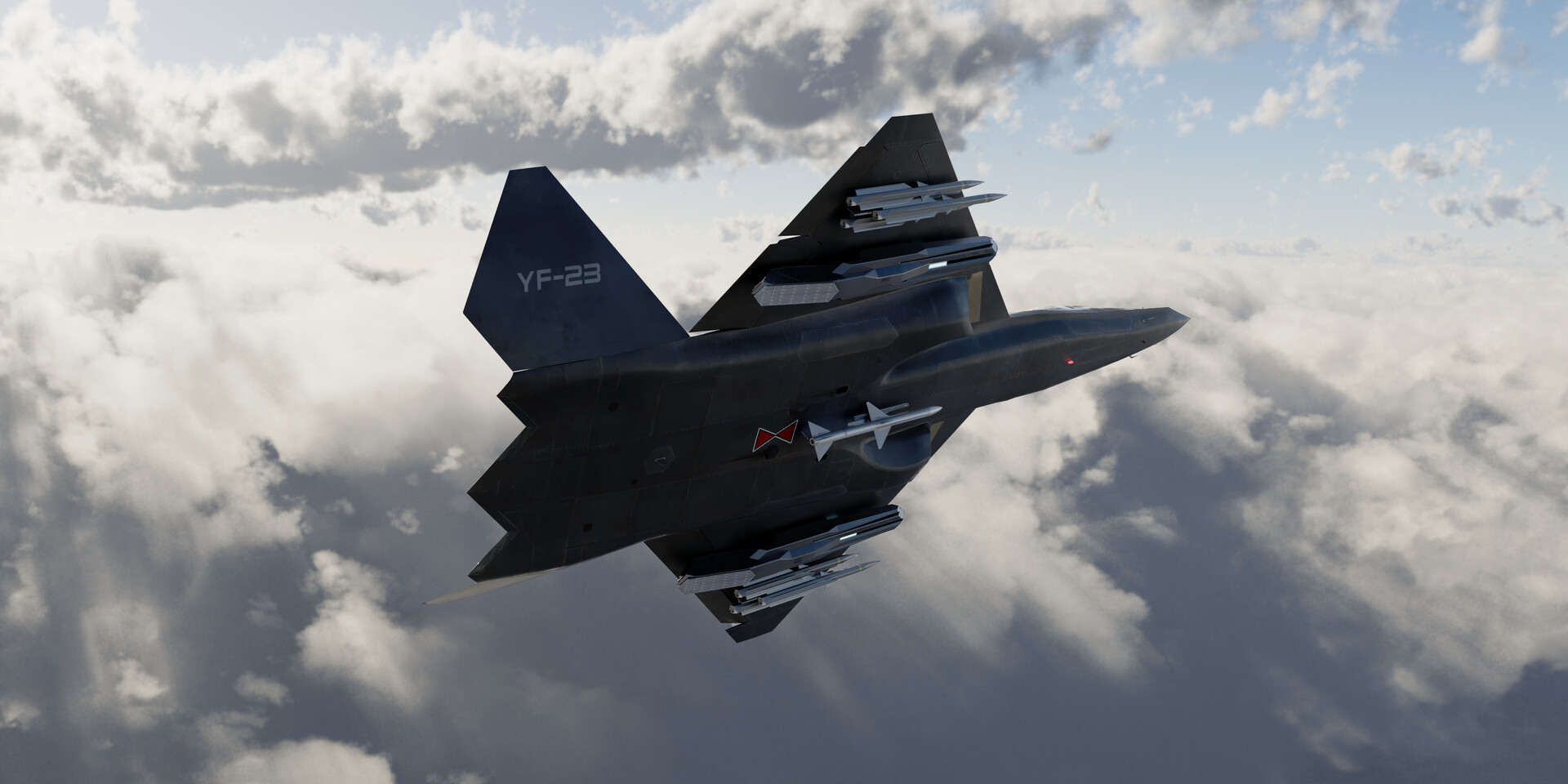
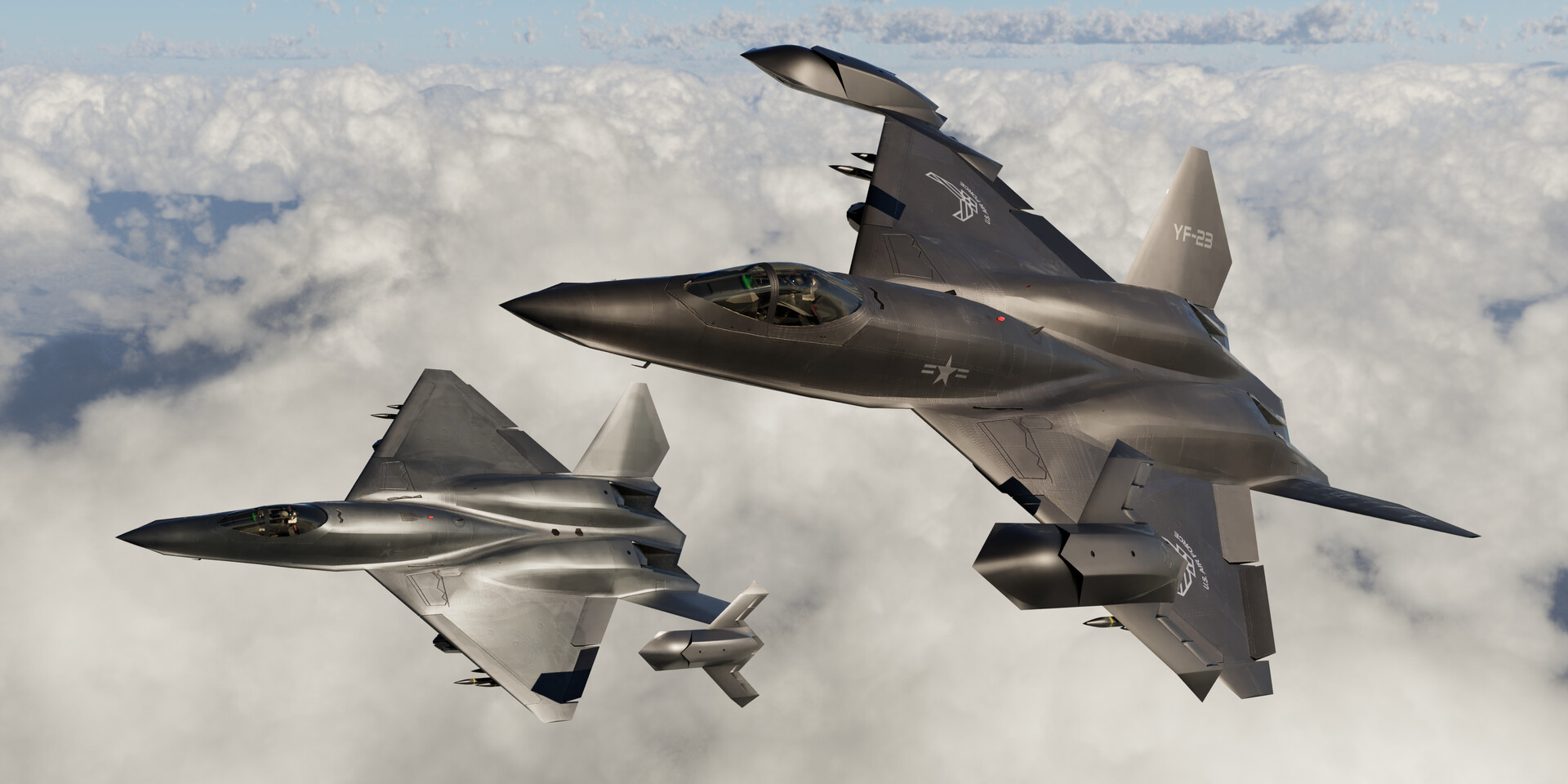
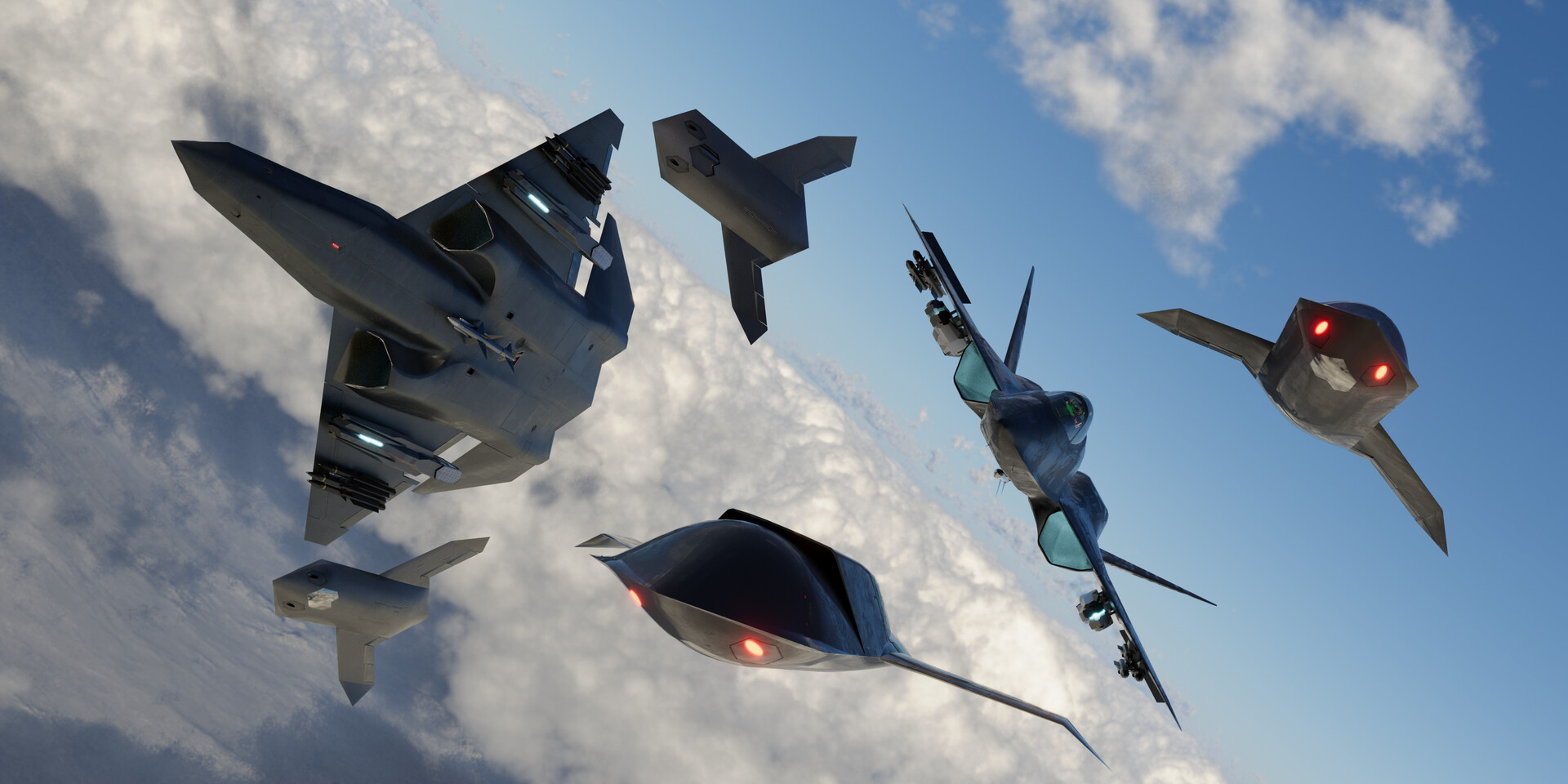
My version is a future intrepetation of what the future Northrop/McDonnell Douglas YF-23 aerial warfare might look like with drones accompanying stealth fighters during active combat missions. This artwork features the intitial two concepts named the 'Black Widow' and the 'Grey Ghost' with their two autonomous combat stealth drones.
In 1981, the Pentagon debuted the Advanced Tactical Fighter (ATF) competition seeking a next-generation stealth fighter that was not only low-observable on radar, but that could also beat new Soviet Su-27 Flanker and MiG-29 Fulcrum fighters in a dogfight. This was a major leap, as the only stealth aircraft yet developed, the F-117 Nighthawk, didn’t possess air-to-air weaponry or supersonic flight capability. The Air Force also wanted the ATF to be capable of super-cruise, sustained supersonic flight without using fuel-gulping afterburners—a challenge given that jet engines fan blades often prove to be an Achilles heel when trying to reduce radar cross-section.
In 1986, competitors for the ATF program were narrowed down to Lockheed-Martin and Northrop, which were then instructed to produce YF-22 and YF-23 prototypes of their respective designs to face off in a competition four years later. By then, both companies had some experience with stealth aircraft design, Lockheed having manufactured the F-117 and Northrop involved in the subsequent B-2 stealth bomber. Northrop also involved McDonnel-Douglas as a sub-contractor.
Lockheed’s YF-22 possessed striking looks, but the YF-23, dubbed the Black Widow II, was truly otherworldly, with diamond-shaped wings to reduce radar observability and a very thin side profile evocative of the SR-71 Blackbird spy plane. Two huge rear tail fins were canted far outwards at a 50 degree angle above the wing, and were rotated by a fly-by-wire system to induce yaw, roll and pitch.
Northrop built two prototypes: the dark grey PAV-1 “Spider” (initially, it even had a Black Widow’s trademark red hourglass on its belly), which first flew June 1990, and the light grey PAV-2 “Grey Ghost” that took to the sky that October. While the former used the same Pratt & Whitney F119 turbofan as the Raptor, the latter used a General Electric YF120 variable-cycle engine which could switch between turbojet and turbofan modes for better low and high-speed performance respectively. The engine inlets used S-Ducts to minimize radar cross section, while heat signature was reduced by channeling exhaust down trenches of heat-absorbent tiles.
The YF-23 prototypes were tested for 65 flight hours. Both had in-flight refueling receptacles and a weapon bay that could accommodate four AIM-120 long-range missiles. Production aircraft would have also incorporated a single 20-millimeter Vulcan cannon and a bay to carry two more short-range Sidewinders missiles. Both YF-22 and YF-23 prototypes did no yet include key systems avionics such as radars.
However, the YF-23 lacked one key feature of the Raptor: heavier vector-thrust engines which could rotate horizontally to assist in executing tight maneuvers at low speed. Thus, the Raptor came to be considered the more maneuverable of the two planes. In reality YF-23 was hardly a slouch in terms of agility, capable of attaining angles of attack sixty or seventy degrees above the vector of the plane even without vector thrust propulsion, but apparently only 25-degree maneuvers were performed before Air Force testers.
In fact, the YF-23 reportedly scored ahead of the Raptor in most categories—demonstrating higher sustained supersonic super-cruise capabilities and longer range. Furthermore, it had an even lower Radar Cross Section, particularly from the side and rear, further reducing the range at which it could be detected.